Common Voice Agent Production Problems and How xMagic Solves Them
Learn the most common production failures in voice agents, structured data errors, weak self-correction handling, and interruption context loss, and how xMagic’s talker-and-reasoner architecture solves them.


Voice agents often look impressive in demos because demos are designed to highlight what the system does well. The flow is usually controlled, the prompts are predictable, the context is clean, and the interaction follows a relatively smooth “happy path.” The user asks the expected question, provides information in the expected format, and the agent responds without much friction. In that setting, a voice agent can appear highly capable, reliable, and nearly human.
Production environments are different in almost every way. Real calls are messy. Users change their minds halfway through a request, correct earlier information, interrupt the agent with side questions, speak ambiguously, skip steps, or ask for things in an unexpected order. They may combine multiple intents into one sentence, provide incomplete answers, or assume the system already understands context that was never clearly stated. On top of that, many real interactions require the agent not just to converse naturally, but to retrieve structured business data, follow policy constraints, maintain state across turns, and recover gracefully when something goes wrong.
xMagic solves these problems with a talker-and-reasoner architecture that separates real-time conversation from complex reasoning and tool execution. The talker keeps the interaction fast, natural, and responsive, while the reasoner handles business logic, data retrieval, and decision-making with greater accuracy and reliability.
1. Inconsistent Structured Data Retrieval
One of the most common production mistakes is asking a language model to read and interpret structured data, such as appointment availability, provider directories, insurance policies, or pricing tables, directly from a general prompt.
This approach may work in simple demos, but it becomes unreliable in real-world scenarios. Instead of performing an exact query against the source data, the agent treats the table as general context and generates an answer based on what appears plausible. The response may sound confident and reasonable even when it is not supported by the actual data.
For example, when a caller asks for an available appointment, the agent should query the scheduling system using precise filters such as provider, location, date, appointment type and insurance plan. It should only present the slots returned by that query. However, many voice agents try to infer the answer from a large block of scheduling data included in the prompt. This can cause them to combine unrelated rows, overlook important conditions or announce appointment times that do not actually exist.
Transcript example
In benchmark testing, competitor agents repeatedly offered unavailable appointment slots because they relied on language model interpretation instead of deterministic data retrieval. In production, this creates more than a simple conversational error. It leads to frustrated patients, incorrect bookings, additional support work, and a loss of trust in the system.
How xMagic solves it
xMagic does not rely on generalized prompting to “read” tables. Our reasoner uses a specialized structured-data query tool for deterministic retrieval—more like a SQL query than a model guess.
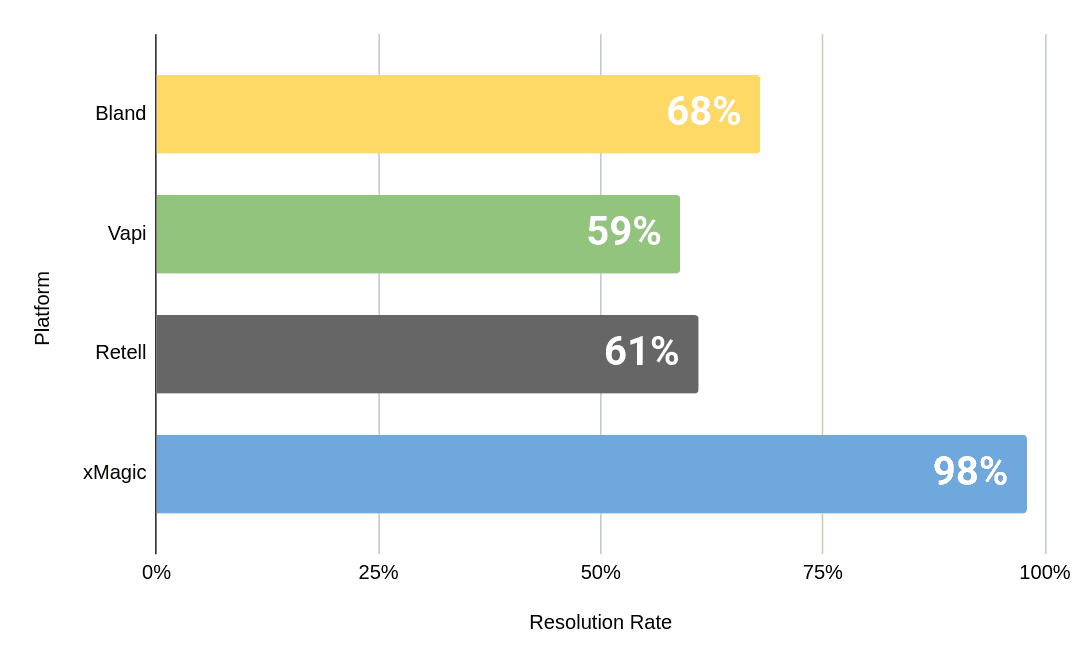
That means users get verified answers, not confident hallucinations. Here is a comparison of our agent’s information retrieval accuracy for structured and unstructured data with other voice agent solutions in the market.
2. Weak Handling of User Self-Correction
In real conversations, users rarely provide information in a perfectly clean, linear way. They change their minds, correct themselves mid-sentence, or add an important detail only after the agent has already started responding. That is where many voice agents begin to break down.
Users might constantly revise themselves:
“Actually, use my other insurance.”
“Wait, not Friday—Monday.”
“Sorry, I meant a different doctor.”
Many voice agents struggle with this because they are built around a flowchart-style path. They are designed to move step by step through a predefined conversation: ask for symptoms, identify a doctor, check insurance, check availability, and confirm the booking. That works only as long as the user stays on the expected path.
But real users do not speak in clean, linear flows. They interrupt themselves, add information late, change their minds, or correct something they said earlier. Once that happens, many agents cannot reliably return to the correct state. The system has already moved forward in the flow, so when the user goes “off chart,” the agent may keep progressing with outdated assumptions instead of resetting and recomputing.
A second failure happens when the agent has already started the next step before the correction arrives. For example, it may already be checking insurance eligibility or appointment availability using the original information. If the user then says, “Actually, use Kaiser, not Aetna,” the earlier request may still be running in the background. The agent acknowledges the correction, but the in-progress logic is still tied to the wrong input.
That creates a dangerous mismatch: the conversation appears to move forward normally, but parts of the system are still using old information, so the user receives an answer that sounds confident even though it is incorrect.
Transcript example
This is a classic production failure: the system begins from one assumption, the user corrects it, but the agent cannot fully get back to the right flow. Instead, it continues executing steps that were already set in motion. The result is stale logic, inconsistent answers, and false confirmations.
How xMagic solves it
With xMagic, the talker can pause execution tied to outdated information and send the corrected state back to the reasoner.
So if the user changes insurance, our system can:
- stop the old task
- validate the new insurance
- rerun doctor availability with the updated data
- respond only with the latest correct result
This prevents contradictions, duplicate bookings, and stale confirmations.
3. Weak Handling of Multi-Tasking
In real voice conversations, users often ask for more than one thing at a time. They may combine multiple requests into a single turn, or introduce a second request before the first one has finished. For example, a user might provide booking details and ask a side question in the same sentence, or ask about clinic hours while the system is still working on appointment availability.
This is where many voice agents struggle.
The reason is that many systems are designed to handle one task at a time in a strict sequence. They can move through a single flow reasonably well, but they often break when the conversation requires them to manage overlapping requests. If a second request arrives before the first task is complete, the agent may switch focus too aggressively, lose track of what was already collected, or fail to return to the earlier task once the new one is answered.
In some cases, the system treats the second request as a full reset. In others, it tries to handle both requests without properly separating them, which causes the state of one task to interfere with the other. Either way, the user experiences the interaction as one continuous conversation, while the system struggles to keep the tasks organized behind the scenes.
Transcript example
In this example, the user is not abandoning the booking task. They are simply asking a second question before the first task has been completed. But after answering the clinic-hours question, the agent loses track of the ongoing appointment request and behaves as if the conversation has started over. The result is unnecessary repetition, broken flow, and a frustrating user experience.
How xMagic solves it
Our talker-and-reasoner architecture allows the system to handle multiple tasks more cleanly.
For example, during an interruption:
- the talker keeps the conversation natural
- the reasoner can check doctor availability and handle the FAQ in parallel
- Both results are returned to the talker
- the talker resumes the original flow without losing information
Our method allows the system to answer the new question, continue or pause the earlier task as needed, and then resume from the correct point without asking the user to repeat themselves. It creates a much smoother user experience and avoids the common “answer one thing, forget the other” failure mode.
Final Takeaway
Voice agents often perform well in demos because demos are controlled. The conversation follows a predictable path, the data is clean, and the system only needs to succeed under ideal conditions. Production is different. Real users interrupt, correct themselves, combine requests, provide incomplete information, and expect the system to stay accurate while interacting naturally in real time.
That is where many voice agents fail. They rely too heavily on generalized prompting, linear flow logic, and single-task conversation handling. As a result, they may return plausible but incorrect answers from structured data, continue operating on stale information after a user correction, or lose track of one request when another appears mid-conversation.
xMagic is designed specifically for these production realities. Our talker-and-reasoner architecture separates fast, natural conversation from deeper reasoning, structured retrieval, and business logic execution. This allows the system to:
retrieve structured data deterministically instead of guessing from prompts
recompute state cleanly after user corrections instead of continuing with outdated assumptions
manage multiple requests in parallel without losing the original task
The result is a voice agent that is not just impressive in a demo, but dependable in production: more accurate, more resilient, and better aligned with the way real conversations actually happen.