The Fastest Way to Turn Ideas Into AI Agents
Building AI agents shouldn't require navigating workflows, integrating platforms and managing infrastructure before a single idea gets tested. The Composer was built to change that, making the path from idea to production-ready AI agent faster, more intuitive and more connected than it has ever been.


AI Agent building has become too complex
Building AI agents today often feels more like wiring infrastructure than creating intelligence. What should be a fast, iterative process turns into navigating workflow graphs, configuring endless settings, debugging prompts across disconnected interfaces and stitching together multiple tools just to get a basic experience working reliably. The complexity doesn't come from the AI itself. It comes from everything around it.
Users are often forced to think about architecture before they can even experiment with ideas.
Need a support agent?
Start with workflows.Need voice support?
Integrate another platform.Need testing?
Switch to another interface.Need safe iteration?
Manually track changes yourself.
The gap between having an idea and shipping a working AI agent is still far larger than it should be.
We think there’s a better way.
Instead of forcing users through rigid configuration layers first, we asked a much simpler question:
What if building AI agents felt like ChatGPT?
That idea became the foundation for our Composer.
Meet the Composer — A conversational AI builder
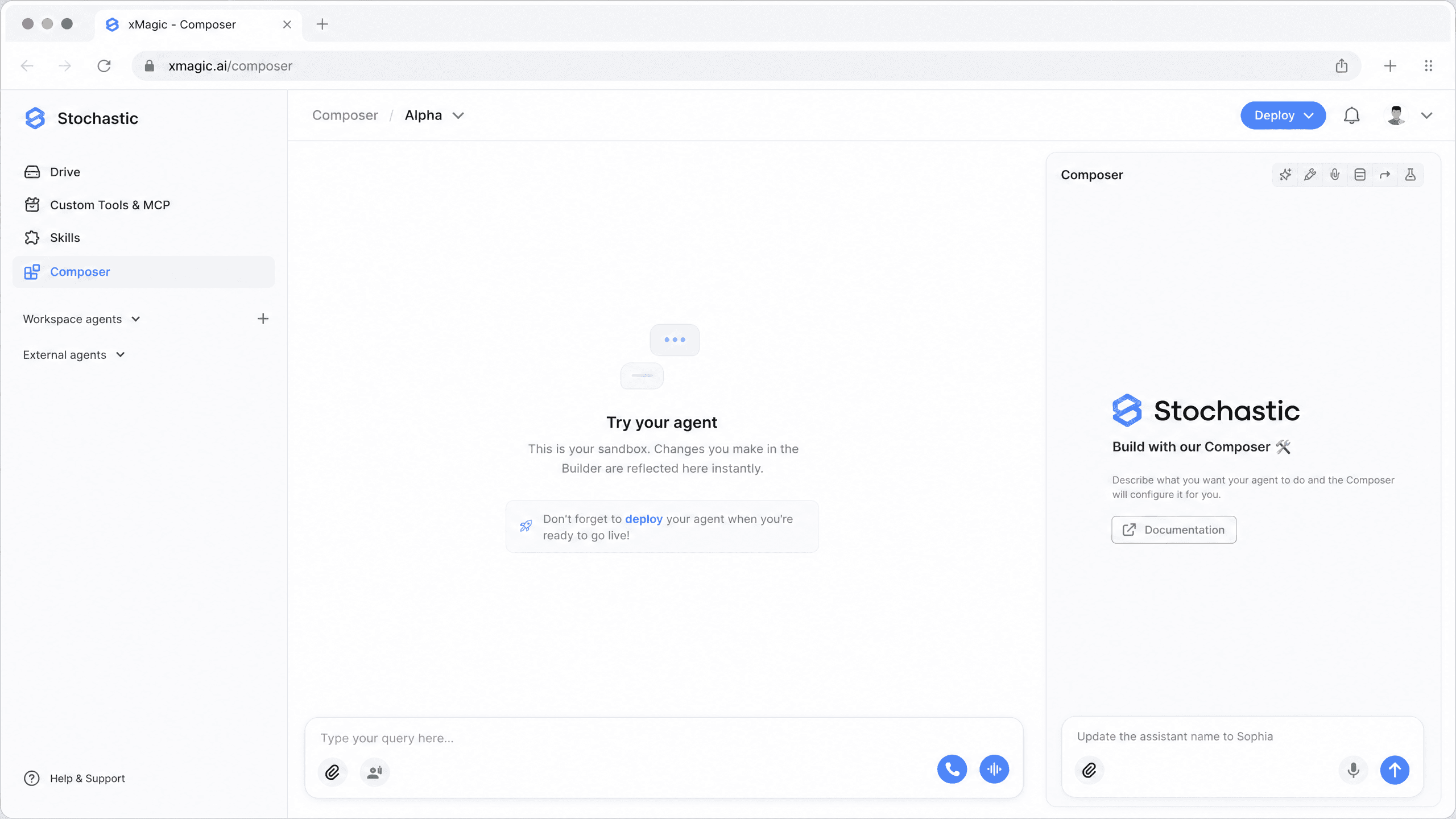
We designed the Composer around a simple belief:
Building AI agents should feel significantly more natural than it does today.
Traditional AI development workflows often require users to think in terms of configurations, system prompts, workflows, integrations and infrastructure before they can properly explore an idea. While these abstractions provide flexibility, they also introduce unnecessary friction into the creation process.
The Composer takes a different approach.
Instead of beginning with complex setup flows, users can describe what they want to build in natural language. The AI Builder understands context, helps structure the system and continuously adapts as the conversation evolves. Refining behavior, adjusting instructions or expanding capabilities becomes part of an iterative conversation rather than a repetitive configuration exercise.
As AI systems grow in sophistication, keeping them manageable becomes increasingly important. Instead of relying on a single monolithic agent to handle every task, the platform is built around an agents and subagents architecture where responsibilities can be distributed across specialized subagents focused on specific workflows or domains.
A customer-facing agent, for example, may coordinate multiple subagents behind the scenes, one handling product knowledge, another managing account actions, and another responsible for escalation logic, while still presenting a unified experience to the end user. The AI Builder understands this architecture natively and helps organize responsibilities intelligently as systems evolve, allowing agents to scale in capability without introducing unnecessary complexity.
The result is an experience that feels simple on the surface while still supporting production-grade AI systems underneath.
Built for fast iteration
AI agents are almost never built correctly on the first attempt. This is not a failure of process, it is simply the nature of building systems that need to behave intelligently across a wide range of unpredictable inputs. The most effective way to develop a reliable AI agent is not to design it exhaustively upfront, but to start with a working version and refine it continuously through real testing.
The Composer was designed with this workflow in mind. Alongside the conversational builder, users have access to a side-by-side playground where agents can be tested immediately as changes are being made. Adjust a prompt, add a tool, modify a guardrail, change how the agent handles a specific type of request and then validate the behavior instantly, without switching environments, without a separate deployment step, without losing the context of what was just changed. The feedback loop between making a change and understanding its effect becomes tight enough that iteration feels natural rather than laborious.
This kind of continuous testing changes how teams think about building. When validation is easy and immediate, experimentation becomes low-risk. Builders are more willing to try approaches they are uncertain about, because understanding the result takes seconds rather than minutes. Over time, this produces better agents, not because any single decision was more inspired, but because more ideas were tested and more feedback was incorporated.
Every change is also tracked automatically in the background. Agents can be versioned over time, creating a clear record of how behavior has evolved and making it straightforward to revisit earlier iterations when needed. If a change produces unexpected behavior in production, rolling back is a deliberate, controlled action rather than a manual reconstruction exercise.
Building AI systems should not feel fragile. It should feel iterative, a process of progressive refinement where each cycle produces a system that is meaningfully better than the last.
Conversational by default. Manual by choice.
A natural concern with conversational development environments is the question of control. If the interface abstracts away the underlying system, does the builder lose visibility into what is actually happening? Can behavior be shaped with the precision that production deployments require?
The Composer was designed specifically to avoid this trade-off. Natural language provides a fast and intuitive way to create and refine agents and it is particularly well-suited to the early stages of development when ideas are still being explored and requirements are not yet fixed. But as systems mature, the need for direct, precise control over underlying behavior becomes increasingly important. Experienced teams need to be able to inspect exactly what instructions an agent is operating under, understand precisely how its tools are configured and make targeted adjustments with confidence that the change will have the intended effect.
To support both workflows, the platform provides a full manual configuration experience alongside the AI Builder. Users can directly access and configure every component of an agent, its system prompts, attached knowledge folders, tools and integrations, skills, guardrails and other behavioral parameters, whenever precision or customization requires it. Nothing is locked away behind the conversational layer. The natural language interface is an accelerant, not a barrier.
In practice, most teams use both modes fluidly. Early exploration and rapid iteration happen conversationally. As a system moves toward production, teams shift toward more direct configuration to ensure precise control over behavior in specific scenarios. When new capabilities are added, the cycle begins again; describe the intent, test the behavior, refine the details. The platform supports this rhythm without forcing teams to choose between speed and control.
From Composer to real-world interactions
The Composer is designed to support the full lifecycle of an AI agent, not just the prototyping phase, but the transition into real-world deployment and the ongoing refinement that follows.
As agents evolve from initial concepts into production-ready systems, they can be deployed directly into real-world interactions without requiring teams to adopt a separate stack for voice or telephony infrastructure. Agents on the platform are voice-capable by default and can be connected to multiple channels like phone numbers, email and fax to handle inbound calls and customer conversations naturally. For many organizations, this significantly reduces operational complexity, because the same system used to build and refine an agent also handles the infrastructure required to deploy it at scale.
Visibility into real-world performance is built into the platform from the start. Call recordings and interaction analytics give teams a clear picture of how agents are performing over time, where they handle situations well, where responses fall short and what patterns emerge across large volumes of real interactions. This data becomes the foundation for the next iteration cycle, closing the loop between deployment and development in a way that is difficult to achieve when those two activities live in separate tools.
This connected lifecycle reflects a core belief about how AI development should work. The gap between building an agent in a development environment and understanding how it performs in production should be as small as possible. When that gap is large and insights from real interactions take days to feed back into the development process, iteration slows and the quality of the system suffers. When the loop is tight, teams can respond to what they learn quickly and the agent improves continuously over time.
The future of building AI Agents
The central challenge in AI development is shifting. It is no longer primarily about what models are capable of, since the capabilities available today already far exceed what most organizations have been able to put into production. The real bottleneck is friction: between an idea and a working system and between a working system and one that performs reliably in the real world.
We built xMagic around the belief that this friction is solvable. Building AI agents should feel natural, iterative and connected and designed around how teams actually think and work, not around the architectural constraints of the underlying technology.
The teams that will move fastest are not necessarily the ones with the most technical resources. They are the ones with the shortest path from idea to production and the tightest loop between deployment and improvement. That is what the Composer is built to provide.