From AI Responses to AI Execution: The Next Layer of Enterprise Automation
Enterprise AI is moving beyond answering questions to executing real work across healthcare workflows, automating tasks like prior authorizations, claims, referrals, and calls while keeping humans involved when judgment is required.


The lane got crowded
For the past two years, enterprise AI has mostly lived in one lane: you ask, it answers. Summarize this chart note. Draft this appeal letter. Explain why a claim was denied. That lane produced real value, and it is now crowded with vendors competing on the same axis, whose model writes the cleanest summary, whose assistant sounds the most helpful.
The organizations pulling ahead in 2026 have moved to a different question: not "what can this system tell me," but "what can this system do without me." A response is information a person still has to act on. Execution is the action itself, a referral classified and routed, a prior authorization assembled and submitted, a denied claim flagged with the exact documentation gap that caused it, before anyone opens the file. That's the distinction we built Stochastic around: not a system that tells a practice what to do about a call or a claim, but one that does it.
Interest is not the same as production
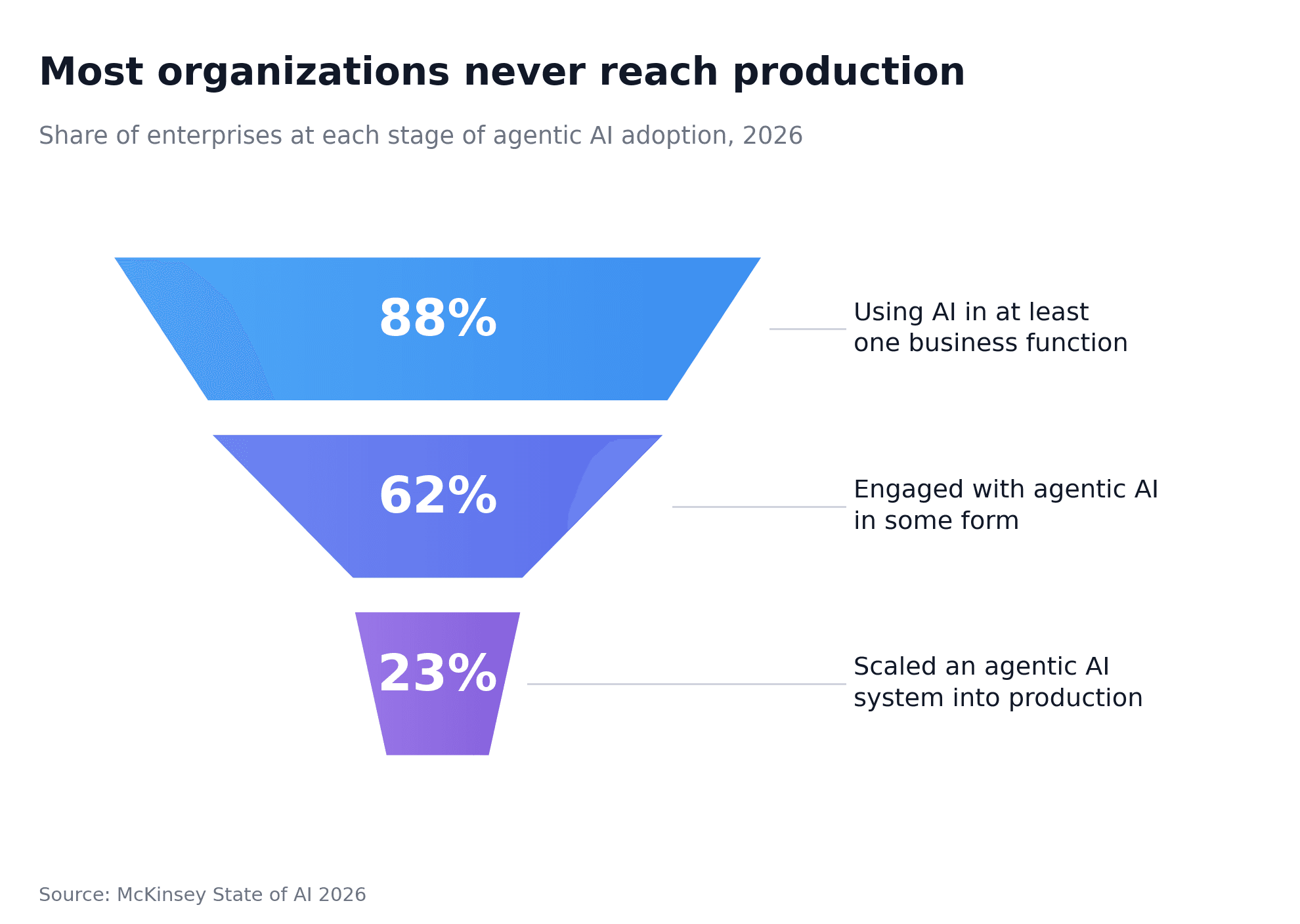
Enterprise applications embedding task-specific AI agents are projected to jump from under 5% to 40% by the end of 2026 [1]. Nearly nine in ten organizations report using AI in at least one business function, and close to two-thirds have experimented with agents. But experimenting and running are different metrics: fewer than a quarter have scaled an agent into production [2]. Gartner expects more than 40% of agentic AI projects to be cancelled by 2027, usually because the business case was never made concrete [1].
Healthcare sits further back than most industries. Production agent adoption in banking and insurance runs close to 47%; in healthcare it's closer to 18% [3]. That gap isn't because healthcare has less to gain. It's because healthcare's hardest problems are execution problems, and most AI tooling was built to answer questions in a chat window, not act inside a claims system, an EHR, or a payer portal. It's also because of the strict data policies around managing PHI. Most agent platforms on the market today simply weren't built to handle protected health information, and retrofitting that later is a lot harder than designing for it from day one. Stochastic's product, xMagic, is built around exactly that constraint: every action it takes runs inside the practice's own trust boundary, with PHI handling, audit logging, and access control treated as core infrastructure rather than something bolted on after a compliance review.
What sits on the other side of that gap
Physicians spend close to two full business days a week on prior authorization work, a figure that has stayed stubbornly flat despite years of payer promises to simplify it [4]. The average practice handles 45 prior auth requests per physician per week, each eating 20 to 35 minutes of staff time, roughly 150 to 260 staff hours a week for a 10-provider practice [5].
Denials compound it. Claim denials cost the US healthcare system an estimated $262 billion a year once rework and administrative overhead are counted [6]. The initial denial rate has climbed from 10.2% in 2020 to roughly 12% today, and the average cost to rework a single denied claim rose from $43.84 to $57.23 in one year [6][7]. Only about 5% of denials are actually for lack of medical necessity; the rest trace back to administrative reasons, missing prior authorization, or reasons insurers don't even bother to categorize [8]. Most of that $262 billion isn't clinical disagreement. It's a process failure, at scale. A lot of that friction is still phone-based: a claim-status inquiry made by phone takes 25 minutes of staff time on average, the longest of any administrative transaction the industry tracks, and cost providers $11 billion in 2023 alone [15].
None of that gets fixed by a better answer to a question someone already knew how to ask. It gets fixed by a system that reads the document, knows what it is, sends it to the right place, and takes the next step, before a person has to touch it.
The anatomy of the execution layer
Turning a language model into something that behaves like a capable coworker inside a workflow, rather than a fast typist next to one, comes down to four pieces working together: document classification, routing, multi-system action, and human-in-the-loop review. Each one solves a different part of the problem, and skipping any single one is usually where an otherwise promising execution project stalls.
Document classification is the entry point: knowing whether something is a referral, an EOB, or a fax of clinical notes with no consistent structure. Get it wrong and every later step inherits the error silently. For voice-first workflows like ours at Stochastic, this shows up as intent classification instead, knowing within the first few seconds of a call whether it's scheduling, billing, or a clinical escalation.
Routing decides where something goes next, under what priority, by what rule. Real routing accounts for exceptions; generic if-this-then-that breaks the first time it meets a case that doesn't fit the pattern, and healthcare is mostly cases that don't fit the pattern.
Multi-system action is where execution happens: updating a record, submitting a form, pushing a claim forward, inside the systems a team already uses. The more sophisticated platforms run multi-agent pipelines, one component for form identification, another for evidence extraction, another for criteria matching, each with its own confidence threshold, routing to a human automatically when confidence drops [9].
Human-in-the-loop, by design, is what makes the rest trustworthy. High-volume, low-stakes steps get automated end to end. Anything with real clinical or financial judgment gets flagged for a person, with full context already assembled. It's the same principle we apply in xMagic: the agent handles the routine call end to end, but the moment it hits something outside its confidence threshold, a patient dispute, an ambiguous clinical detail, it hands off to staff with the full call context already summarized, not a blind transfer.
Where this is already working
This isn't a hypothetical layer. It's already live in production at real health systems, and the results show up in the same metrics ops teams already track: approval time, staff hours, bed wait times.
Surescripts' Prior Authorization Automation, live across 42 health systems and roughly 68,000 prescribers, now delivers a median approval time of 18 seconds when a request meets criteria [10]. Develop Health's work with Calibrate cut prior auth volume 80 to 85% simply by surfacing coverage requirements upfront instead of submitting blind [9]. Microsoft's healthcare agent orchestrator, in use at Stanford, Johns Hopkins, and Mass General Brigham, is cutting tumor board prep from hours to minutes by pulling imaging, pathology, and genomic data into one workflow [11]. Peterborough Regional Health Centre used agentic tooling to cut average inpatient bed wait times 43% and ambulance offload times roughly 70% [12].
Regulation is pushing the same direction. Starting in 2026, CMS requires payers to return prior auth decisions within 72 hours for urgent requests and 7 days for standard ones. By January 2027, payers must run FHIR-based APIs instead of fax workflows, a rule CMS estimates will save $15 billion over the next decade [13].
That transition won't happen overnight. Most payers will run fax and FHIR-based APIs in parallel for years, and a system built for only one side of that shift will break the moment a payer it works with hasn't migrated yet. xMagic handles both: it can work a request through a fax-based workflow today and the same request through a FHIR API tomorrow, without the practice having to know or care which one a given payer is on.
That's the same problem underneath the phone calls, too: work that arrives with no clean structure, where the rules differ by payer, provider, and practice. We split the architecture into a fast conversational layer and a slower reasoning layer, so the call stays natural while classification, routing, and the actual system actions happen underneath it, grounded in the practice's own data [14]. The reasoning layer doesn't just decide what to say back to the caller. It decides what to do next: pull the right record, check the right payer rule, update the right field, so the call ends with something actually resolved instead of a promise to follow up.
The honest tensions
Confidence without accountability is how projects end up cancelled. An agent acting inside a claims system with no visibility into its own uncertainty will eventually take a wrong action at scale, faster than a human ever could. A system that acts inside a practice's scheduling, billing, and EHR systems has to be right about what it changes, not just fast about it, which is why every action xMagic takes is logged and traceable back to the call that triggered it, and why we treat audit logging and confidence scoring as non-negotiable rather than a feature we'll get to later. Integration debt, not model quality, is usually the real bottleneck: an execution agent is only as good as the systems it can reliably call, and every EHR and payer portal has its own quirks. And not every workflow should be automated end to end. The instinct to remove a person from every step is backward. High-volume, low-variance work should run on its own; anything with real judgment attached should stay human-reviewed, just faster to reach.
The question worth asking
Enterprise ops and healthcare leaders evaluating AI vendors should stop leading with "how good are the answers." The sharper question: what does this system actually do on its own, inside the workflow that already exists, before it needs a person to step in. We built xMagic because we kept hearing the same complaint from practices: their AI could talk, but it couldn't do real work. That's the layer worth building for, and the layer worth buying for.
References
Gartner. "2026 Hype Cycle for Agentic AI." Link
McKinsey & Company. "The State of AI: Global Survey 2026." Link
S&P Global. "S&P Global Report Charts Enterprise Race to Build AI Agent-Ready Infrastructure." Link
American Medical Association. "2025 AMA Prior Authorization Physician Survey." Link
AMA/MGMA 2025 Revenue Cycle Benchmark Report, cited in US Tech Automations. Link
Experian Health. "State of Claims 2025 Report." Link
Premier Inc. "Claims Adjudication Costs Providers $25.7 Billion." Link
KFF. "Claims Denials and Appeals in ACA Marketplace Plans in 2024." Link
Develop Health. "AI Prior Authorization: Real-Time Approvals & Automation in 2026." Link
Surescripts. "Surescripts Expands Prior Authorization Automation." May 20, 2026. Link
Microsoft. "Developing next-generation cancer care management with multi-agent orchestration." Link
Microsoft. "Building the foundation for agentic AI in healthcare." Peterborough Regional Health Centre case study. Link
Centers for Medicare & Medicaid Services. "CMS Interoperability and Prior Authorization Final Rule (CMS-0057-F)." Link
Stochastic. "Common Voice Agent Production Problems and How xMagic Solves Them." August 25, 2026. Link
Merits. "The 25-Minute Phone Call." CAQH Index data. Link