Institutional Intelligence: Every Enterprise's Own AI
The next enterprise moat is institutional intelligence: AI that understands how your organization thinks, decides, and works.


The moat moved
For two decades we said data was the moat. Enterprises built warehouses and scaled out CPU clusters to crunch terabytes that no laptop could handle, and the insights that came out were a real competitive edge. Even after deep learning arrived in 2012, the pattern held. A company would take an open model it could download, BERT or its lighter cousin DistilBERT [1][2], fine-tune it on its own data, serve it from its own cloud, and own the whole loop from data to model to prediction.
GPT-3 and then ChatGPT changed the shape of that loop [3][4]. Training a frontier model became a game only a few labs could afford, and the GPUs went to them. Intelligence stopped being something an enterprise built and became something it rented. The concentration shows up in the capital: in the first quarter of 2026 alone, OpenAI raised $122 billion, Anthropic $30 billion, and xAI $20 billion, three of the five largest venture rounds ever recorded [5]. Across the first half of the year, AI startups raised more than $407 billion, past the $264 billion the sector took in all of 2025, and OpenAI and Anthropic alone accounted for about $217 billion of it [6]. That capital bought general capability, and the models are remarkable. It also bought a dependency.
Renting has costs that do not show up on the invoice. The first is that your work trains someone else's model. Every enterprise that routes its work through a public API is, in aggregate, teaching the lab what expert work looks like, and the labs have built an industry around it. Mercor, one of the largest suppliers of expert training data, pays out more than $1.5 million a day to a network of more than 30,000 contractors including physicians, lawyers, and bankers, and counts OpenAI, Anthropic, Google, and Meta among its customers [7][8]. The tacit knowledge that used to live inside firms is being extracted, one contractor at a time, to improve a model everyone will rent at the same price. The second cost is exposure: prompts, documents, and decision records leave your perimeter for infrastructure you do not control, under retention and residency terms you did not write. The third is that the terms are not yours at all. Pricing, rate limits, and model behavior change on the vendor's schedule, and a workflow tuned to one version can quietly degrade when the next one ships.
Cautious enterprises have noticed, and many have restricted where external models are allowed to touch their work. Restriction is a defensive answer. This article is about the offensive one: building what we call institutional intelligence, an AI that carries what your organization knows, decides the way it decides, and lives where its work gets done.
Where the next gains come from
The scaling strategy of the past five years assumed that more compute on more internet text would keep producing new capability. It did, and general capability will keep improving; the frontier labs and the open-weight community are pouring capital and talent into it, and everyone benefits from that. But the source of the gains is shifting. Language fluency, general coding, and broad world knowledge were latent in the public corpus, and larger models surfaced them. The public corpus is finite, and what it can teach is saturating.
David Silver and Richard Sutton described the next phase in their 2025 paper "Welcome to the Era of Experience." Their argument is that in the domains that matter most, the knowledge extractable from human data is approaching a limit, that most high-quality data sources have already been or soon will be consumed, and that further progress depends on agents learning from the experience of doing tasks rather than from reading about them [9]. For enterprises this is the central fact. General capability will be shared, and it will keep getting better. The uncharted territory is specific, expert, situated work, and the most valuable data for shaping intelligence in that territory is the trace of how the work actually gets done: the decisions, the corrections, the exceptions, the outcomes.
That data does not live on the internet. It lives inside institutions.
Naming the category
Institutional intelligence is AI that embodies an organization's accumulated knowledge, judgment, values, and ways of working. It is not a tool the enterprise uses; it is a capability the enterprise has.
A tool is the same in your hands as in your competitor's. A capability persists when people leave and improves with use. It is also not something anyone can sell you: a copy dropped into another firm would answer questions no one there is asking and defer to decisions no one there made, because it is a rendering of the organization that produced it. Others will build their own. They cannot use yours.
It is worth separating this from things it will be confused with. Institutional intelligence is not "enterprise AI," which mostly describes procurement terms around a shared model. It is not retrieval over your documents; a system that can quote your policies does not understand how your organization operates, because most of what matters was never written down. It is not a fine-tuned chatbot: fine-tuning is one of the mechanisms institutional intelligence uses, but a general model wearing a layer of your vocabulary, sitting in a window next to the work, is not the thing. And it is not a copilot, which helps an individual work faster. Concretely, it is a whole system, model and memory and data and the workflows it runs inside, that has absorbed how your organization handled the last ten thousand cases and brings that to bear at the moment the next one arrives. Institutional intelligence is an organizational asset that individuals happen to access.
Why generic AI hits a ceiling
Three observations explain why a shared model cannot get you there on its own.
Institutional knowledge is mostly tacit. The senior underwriter does not consult a rule; she looks at a file and something feels off. Documentation captures the explicit residue of expertise and misses the substance. Better documents do make for better context, so this is not an argument against writing things down. It is an argument against making that the prerequisite: you cannot tell a customer to document how they work first, so that you can implement it afterwards. A forward-deployed engineer earns her value precisely by not waiting for that document; she sits with the team and learns the process from the work itself. Institutional intelligence has to learn the same way.
Context, not model access, is the differentiator. Any enterprise can license any frontier model. What no vendor can sell is the ten thousand small decisions, exceptions, and lessons that make your organization behave the way it does. The model is the engine. Context is the map and the driver's memory of every road that flooded last spring.
Convergence is invisible from the inside. When every firm's analysts use the same model with similar prompts, output converges on the same median quality. Inside any one company it looks like progress. It only becomes visible when a competitor's memo reads exactly like yours. The common failure mode, bolting a chatbot onto a wiki and calling it transformation, is convergence with better manners.
The anatomy of institutional intelligence
Four layers, each built on the one beneath it.
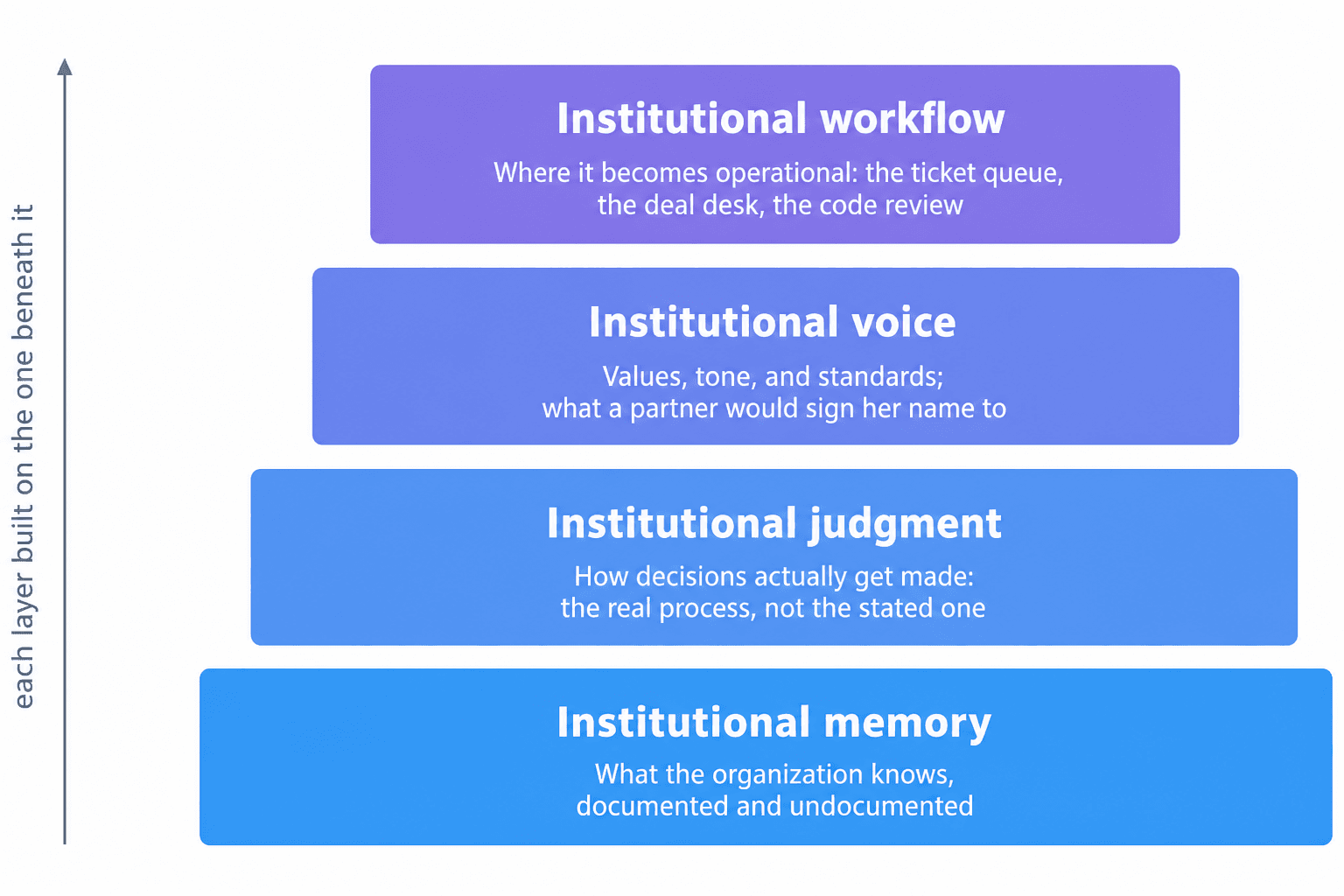
Institutional memory is what the organization knows, documented and undocumented: the decisions and their reasons, the incidents and their post-mortems, the customer histories and the patterns within them. A pharmaceutical company's memory holds not just every trial protocol but which protocols were amended, why, and what regulators said. The test is not "can it find the document" but "does it know what happened."
Institutional judgment is how decisions actually get made. Every organization has a stated process and a real one. Judgment encodes the real one: which risks are tolerated, how speed is traded against certainty, when a manager can act alone. An insurer's judgment includes knowing that a certain class of claim is always escalated because of a lawsuit no one outside the department remembers. Much of this has never been written down, and it does not have to be. Given enough decision traces, a model can pick up the regularities that actually drive outcomes without anyone naming them first, much as deep learning made hand-engineered features unnecessary.
Institutional voice is values, tone, and standards. It is what a partner would sign her name to, what the brand will not say even when it would persuade, the level of rigor an engineering review expects. Voice is what lets AI produce work that does not have to be rewritten before it leaves the building.
Institutional workflow is where the intelligence becomes operational. Knowledge that must be sought out mostly goes unused. Workflow puts memory, judgment, and voice inside the ticket queue, the deal desk, the code review. A logistics company with strong workflow does not have an AI you ask about routing exceptions; it has exceptions that arrive already annotated with what the company knows about that lane and that carrier.
Memory without judgment is a library. Judgment without voice makes decisions that do not sound like you. Voice without workflow is a brand book nobody opens.
What changes
Picture a new hire at an engineering firm, three weeks in, reviewing a structural design for a ten-year client. Without institutional intelligence, she applies what she learned in school and misses everything specific to this client, this site, and this firm. She learns those things over two years, mostly through mistakes a senior colleague catches.
With it, her review starts with the firm's experience at her elbow: this client's two previous seismic issues, the internal standards that exceed code, a 2021 memo about a similar failure mode, the firm's habit of speaking to this client more directly than most. She still does the review and is still accountable. But the institution has learned to teach.
At the other end of the career, a claims adjuster retires after twenty-eight years. In most organizations her knowledge of fraud patterns and reasonable regional attorneys leaves with her, and no one can say what was lost. With institutional intelligence, her decisions and corrections have become part of the organization's judgment over time. Her retirement is the loss of a colleague, not a capability.
And the system compounds. A CRM does not get better at selling because you used it for five years. An institution with its own intelligence does.
The maturity path
Most enterprises sit at one of four stages.
Scattered tools. Individuals use several AI products with no shared context. Every conversation starts from zero. Gains at the edges, nothing at the core. This is where most enterprises are.
Connected knowledge. AI can reach documents and systems of record. Retrieval works and answers are grounded. This is a real step, and where most programs stall, because leadership expected an intelligent colleague and got a well-read intern.
Embedded judgment. The organization has captured how it decides, not just what it knows. Decision histories and expert corrections are in the system, and it lives inside workflows rather than in a separate window. This is where institutional intelligence properly begins.
Self-improving institution. Feedback loops are closed. Outcomes flow back into judgment. Expertise is captured as it forms rather than recovered at retirement. Few organizations are here, and the gap they open widens each quarter.
The stages are sequential, though the boundaries blur in practice: capturing judgment already requires some feedback, and the last two stages differ mostly in how completely the loop is closed. You cannot skip to embedded judgment without connected knowledge, and you cannot reach self-improvement without the feedback infrastructure that judgment requires.
The early movers
This is no longer theoretical, and the past month has produced the clearest examples yet.
Thomson Reuters. On August 24, 2026, the company launched Thomson, its first proprietary large language model. It started from an open-source foundation and spent about $40 million specializing it on decades of Westlaw, Practical Law, Checkpoint, and Reuters content, with hundreds of its own experts defining training objectives and judging outputs in blind comparisons [10][11]. Its CTO's framing matches the thesis of this article: a model that embodies the expertise the company possesses is core to the business, because AI is a new mechanism for delivering expertise [11].
Harvey. Four days earlier, the legal AI company released Tenet, its first proprietary model, after years of building on closed models from OpenAI, Anthropic, and Google [12][13]. Tenet is post-trained on the open-weight Kimi K3 base using reinforcement learning in legal task environments, and completes almost twice as many held-out tasks on Harvey's Legal Agent Benchmark as the base model at roughly the same cost per task, with no customer data in training [14][15]. It is still a research preview scored largely on Harvey's own evaluations, but the goal is stated plainly: give law firms a path to owning their own specialized models [15].
Cursor. Cursor's Composer 2 technical report describes the same route in software: continued pretraining on the open Kimi K2.5 base, followed by large-scale reinforcement learning inside realistic Cursor sessions, using the same tools and harness the deployed model uses, on a task distribution drawn from what developers actually ask it to do [16].
Stochastic. We built our own model for the same reasons, specialized on healthcare administration, where the work arrives as phone calls and messy conversation and the rules differ by payer, by provider, and by practice. The architecture differs too: xMagic separates a fast talker from a slower reasoner, so the conversation stays natural in real time while business logic, structured retrieval, and decisions are handled deliberately and grounded in the customer's own systems rather than guessed from a prompt [17]. Like the others, we started from open foundations, invested in what our customers uniquely hold, and kept their data inside their control.
The pattern is consistent. None of these companies tried to out-build the frontier labs on general capability; each took it from a strong open foundation, which is where the expensive part now comes from. Each invested instead in what it uniquely held: proprietary content, expert judgment, and the traces of real work in a real environment. Each kept its customers' data out of the training set. And each did it for a small fraction of what a frontier pretraining run costs. That is what institutional intelligence looks like in practice.
Objections and honest tensions
A category that cannot survive its critics is not a category.
Collective intelligence. A model trained on the work of many firms in one sector has seen corner cases any single firm has not, which is a real advantage, and it is one the shared base models will keep absorbing. Institutional intelligence is designed to ride that improvement rather than compete with it. But what a sector model learns from a set of peers is, by construction, what those peers have in common. The remaining difference, the client history, the risk appetite, the standards, the accumulated exceptions, is what institutional intelligence is for.
Governance and security. Institutional intelligence concentrates your most sensitive knowledge into a system that reasons and acts. Access control is harder than in a document store, because the system can synthesize what no single document reveals. Treat it with the seriousness you give your financial systems.
Encoding bias. If the system captures how your organization decides, it captures the bad decisions too. An institution that has been wrong for twenty years can now be wrong at scale with a confident tone. Build in mechanisms for audit, challenge, and deliberate unlearning. The best version can tell you what your institution believes and why you should question it.
Build versus buy. No vendor can sell you your institutional intelligence, because its substance is yours. But almost no enterprise should build models and infrastructure from scratch, and the early movers did not. The foundations will be bought or adopted openly; the intelligence must be built. Mistaking one for the other is how companies end up at stage two permanently.
Human expertise. If the system carries ten years of judgment, what is the senior person for? The honest answer is that the role changes rather than disappears. Thomson Reuters put hundreds of its experts at the center of training and evaluation [11]; Harvey's training environments were scored against expert rubrics [14]. The expert becomes the curator, critic, and source of new learning for the institution's intelligence. That is a more valuable role, but a different one, and organizations that ignore the shift will find that the people who feed the system stop feeding it.
The inevitability frame
In 1995 a company website was a novelty. By 2000 it was expected. By 2005 the question was whether it was any good. The data warehouse followed the same arc, and so did cloud strategy. Each was a layer every enterprise eventually had to own, not rent. Each looked optional until it did not.
Institutional intelligence is the next such layer. The base models will be shared. The infrastructure will be shared. What cannot be shared is an AI that knows what your organization knows, decides how it decides, and lives where its work gets done. That is not only something to protect; it is something to put to work. Every decision, correction, and exception your people produce either compounds into an asset the institution owns and can build on, or dissipates into generic tools and point solutions that leave you exactly as capable as everyone else using them. The choice is not whether your intelligence will be used to train a model. It is whose model.
Your company is intelligent. Your AI should be too. That is what institutional intelligence means.
References
Devlin, Jacob, Ming-Wei Chang, Kenton Lee, and Kristina Toutanova. "BERT: Pre-training of Deep Bidirectional Transformers for Language Understanding." arXiv:1810.04805, October 2018. Link
Sanh, Victor, Lysandre Debut, Julien Chaumond, and Thomas Wolf. "DistilBERT, a distilled version of BERT: smaller, faster, cheaper and lighter." arXiv:1910.01108, October 2019. Link
Brown, Tom B., et al. "Language Models are Few-Shot Learners." arXiv:2005.14165, May 2020. Link
OpenAI. "Introducing ChatGPT." November 30, 2022. Link
TechCrunch. "Startup funding shatters all records in Q1." April 1, 2026. Link
PitchBook. "Half of AI's record $407B went to OpenAI, Anthropic in H1 2026 as mega-deals reign." August 10, 2026. Link
Contrary Research. "Report: Mercor Business Breakdown & Founding Story." Link
TIME. "AI Is Learning to Do the Jobs of Doctors, Lawyers, and Consultants." April 13, 2026. Link
Silver, David, and Richard S. Sutton. "Welcome to the Era of Experience." Google DeepMind, April 2025. Link
Thomson Reuters. "Thomson Reuters Leverages its World-Class Data Assets to Launch Its Own Frontier Model." Press release, August 24, 2026. Link
SiliconANGLE. "Thomson Reuters launches proprietary AI model for legal work." August 24, 2026. Link
OpenAI. "Customizing models for legal professionals." Harvey customer story. Link
South China Morning Post. "OpenAI-backed legal tech firm pivots to Chinese Kimi K3 open-weight model." August 2026. Link
Fireworks AI. "Post-training Kimi K3 with Harvey for long-horizon legal work." August 2026. Link
Harvey. "Harvey Tenet Research Preview." August 20, 2026. Link
Cursor. "A technical report on Composer 2." March 2026. Cursor , arXiv
Stochastic. "Common Voice Agent Production Problems and How xMagic Solves Them." August 25, 2026. Link